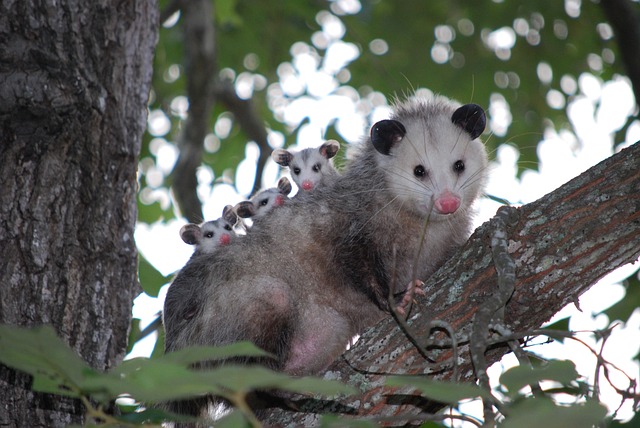
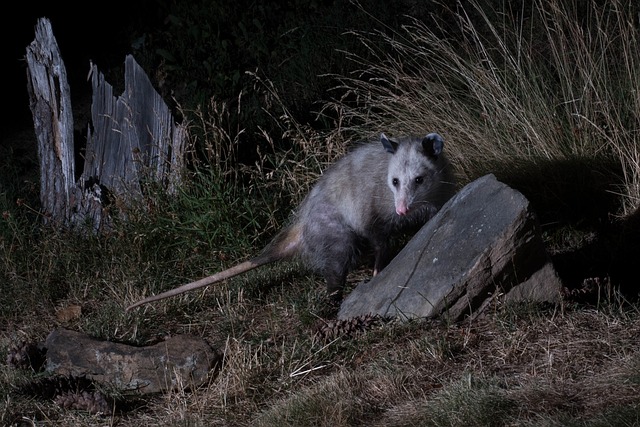
Opossums are awesome!!!!
Opossums (/əˈpɒsəmz/) are members of the marsupial order Didelphimorphia (/daɪˌdɛlfɪˈmɔːrfiə/) endemic to the Americas. The largest order of marsupials in the Western Hemisphere, it comprises 126 species in 18 genera. Opossums originated in South America and entered North America in the Great American Interchange following the connection of North and South America in the late Cenozoic.
The Virginia opossum is the only species found in the United States and Canada. It is often simply referred to as an opossum, and in North America it is commonly referred to as a possum (/ˈpɒsəm/; sometimes rendered as 'possum in written form to indicate the dropped "o").
The Australasian arboreal marsupials of suborder Phalangeriformes are also called possums because of their resemblance to opossums, but they belong to a different order. The opossum is typically a nonaggressive animal and almost never carries the virus that causes rabies.
Etymology
The word opossum is derived from the Powhatan language and was first recorded between 1607 and 1611 by John Smith (as opassom) and William Strachey (as aposoum). Possum was first recorded in 1613. Both men encountered the language at the English settlement of Jamestown, Virginia, which Smith helped to found and where Strachey later served as its first secretary. Strachey's notes describe the opossum as a "beast in bigness of a pig and in taste alike," while Smith recorded it "hath an head like a swine ... tail like a rat ... of the bigness of a cat." The Powhatan word ultimately derives from a Proto-Algonquian word (*wa·p-aʔθemwa) meaning "white dog or dog-like beast."
Following the arrival of Europeans in Australia, the term possum was borrowed to describe distantly related Australian marsupials of the suborder Phalangeriformes, which are more closely related to other Australian marsupials such as kangaroos.
They similarly have didelphimorphia, two (di) wombs (delphus).
Evolution
Opossums are often considered to be "living fossils", and as a result they are often used to approximate the ancestral therian condition in comparative studies. But this is a mistake, because the oldest opossum fossils are from a more recent epoch, the early Miocene (roughly 20 million years ago).
The last common ancestor of all living opossums dates approximately to the Oligocene-Miocene boundary (23 million years ago) and is at most no older than Oligocene in age. Many extinct metatherians, such as Alphadon, Peradectes, Herpetotherium, and Pucadelphys, were once considered to be early opossums, but it has since been recognized that this was solely on the basis of plesiomorphies; they are now considered to belong to older branches of Metatheria that are only distantly related to modern opossums.
Opossums probably originated in the Amazonia region of northern South America, where they began their initial diversification. They were minor components of South American mammal faunas until the late Miocene, when they began to diversify rapidly. Before that time, the ecological niches presently occupied by opossums were occupied by other groups of metatherians such as paucituberculatans and sparassodonts.
Large opossums like Didelphis show a pattern of gradually increasing in size over geologic time as sparassodont diversity declined. Several groups of opossums, including Thylophorops, Thylatheridium, Hyperdidelphys, and sparassocynids developed carnivorous adaptations during the late Miocene-Pliocene, before the arrival of carnivorans in South America. Most of these groups, with the exception of Lutreolina, are now extinct. It has been suggested that the size and shape of the ancestral Didelphid’s jaw would most closely match that of the modern Marmosa genus.